


Small businesses in Nigeria no longer struggle with getting online. In most cases, they are already there.
They run Instagram pages, WhatsApp catalogues, TikTok accounts, paid ads, product videos, and even influencer campaigns. Yet after the content goes live and ad budgets are exhausted, many business owners are left with one pressing question:
Where are the customers?
This question formed the core of TikTok’s latest push toward empowering Nigerian small and medium-sized enterprises (SMEs).
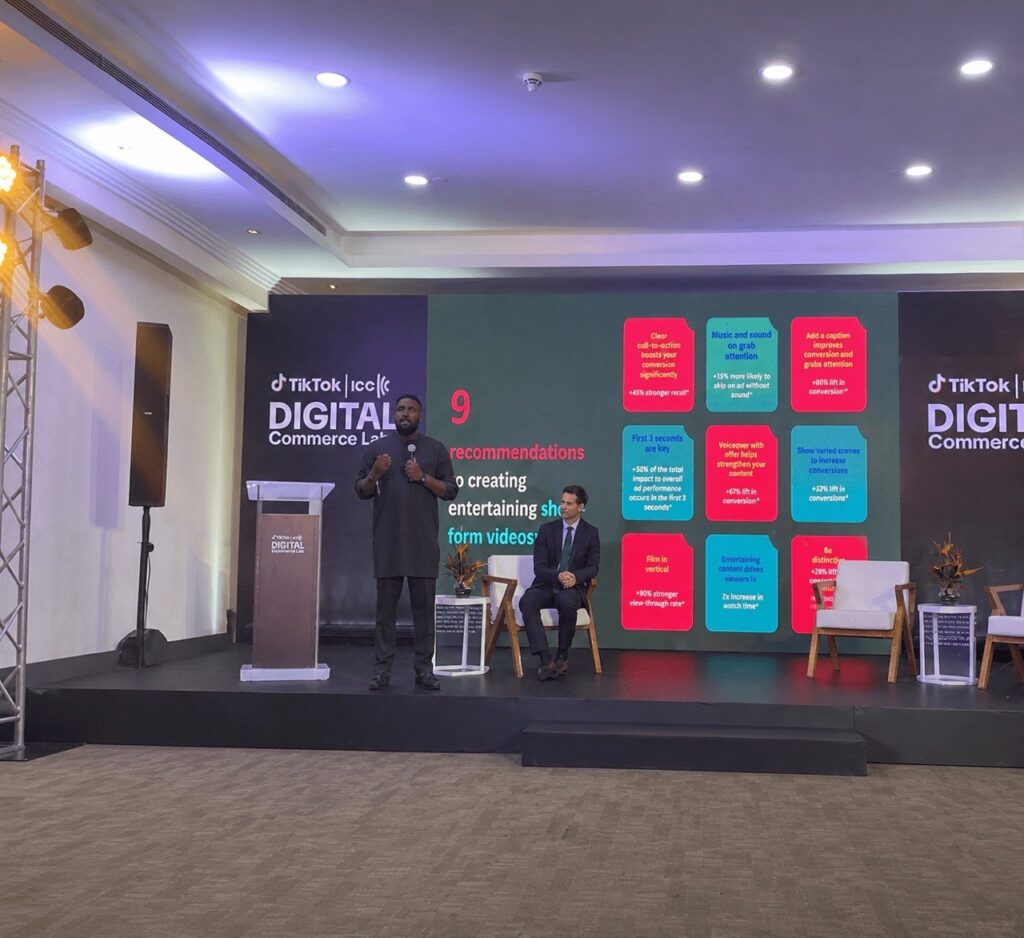
At the launch of its Digital Commerce Labs in Lagos, TikTok introduced a new AI-powered advertising tool called Symphony, designed to help businesses create full advertisements from simple text prompts in minutes.
The message was clear: SMEs no longer need expensive agencies, professional video teams, or advanced marketing skills to produce high-quality marketing content.
But beneath this innovation lies a deeper issue.
If content creation is becoming easier than ever, why are so many businesses still struggling to grow?
The Real Challenge Facing Nigerian SMEs
During the event, TikTok shared a statistic that shifts the conversation away from content creation.
According to the company:
- 40% of SMEs fail because they cannot generate enough customer demand
- 19% struggle with competition
- 17% cite weak product offerings as a key challenge
These insights reveal an important truth.
For years, digital marketing advice focused heavily on visibility. Businesses were told to build websites, post on social media, run ads, and collaborate with influencers.
But TikTok also noted that a large percentage of SMEs are already active online. The problem is no longer presence.
It is performance.
Read Also: TikTok Rolls Out £3.99 Monthly Ad-Free Subscription in the UK
AI Can Create Ads, But It Cannot Create Demand
TikTok’s Symphony tool solves one major part of the marketing process: content production.
Now, a business can generate multiple advertisements in minutes without needing technical expertise.
However, AI does not automatically generate customer demand.
A business can produce ten ads in a day, but if the product is poorly positioned, overpriced, or targeted at the wrong audience, AI only helps distribute those weaknesses faster.
This is a critical reality many small businesses overlook.
Technology can amplify strategy, but it cannot replace it.

TikTok Is Redefining How Customers Are Reached
TikTok believes its platform has changed the traditional rules of digital marketing.
Unlike older social platforms that reward follower count, TikTok emphasizes content performance.
As explained during the event:
“When you start on TikTok, it’s the age of content. It’s not about the followers that you have. It’s about the quality of the content.”
This means that even small businesses can compete with larger brands if their content resonates with users.
In theory, this levels the playing field.
A business with a few hundred followers can achieve the same visibility as one with hundreds of thousands, if the content performs well.
Consistency Still Wins Over Virality
Real-world experiences shared at the event reinforced this idea.
A fashion entrepreneur, Oluwatobi Anointing, explained that her journey did not start with instant success.
“I was posting my business for three months every day, and nobody bought anything from me. But I kept showing up.”
Her story highlights a key truth about digital growth: consistency matters more than quick viral moments.
Similarly, Dr. Olawale Ogunlana, founder of Healthkraft Africa, emphasized that content does not need to be entertaining to succeed.
“You don’t need to be funny. You just need to be real. Solve real problems for people.”
This shows that successful content is built on relevance, not production quality.
If Everyone Has AI, Content Stops Being the Advantage
As AI tools like Symphony become widely available, content creation itself becomes less of a competitive advantage.
When every business can generate professional-looking ads in seconds, the real differentiator shifts.
Businesses will compete more on:
- Storytelling
- Brand trust
- Customer understanding
- Product quality
- Community engagement
In this new environment, AI levels the playing field, but also raises the competition.
TikTok’s Bigger Goal: Automated Advertising
While Symphony attracted attention, TikTok’s broader strategy is even more significant.
The platform also introduced AI-powered advertising systems designed to automate campaign decisions.
These systems analyze user behavior at scale to determine who should see which ads, when, and how often.
This approach is similar to strategies already used by major tech companies.
Meta has rolled out AI-driven advertising tools such as Advantage+, while Google continues to expand Performance Max campaigns.
TikTok is now aligning with this trend.
The goal is simple:
Businesses focus on their products while AI handles advertising execution.
During a demonstration, a presenter summarized it clearly:
“I want to run an ad for my product. This is the website link. Please help me run my ad. It just does it.”
For small business owners managing multiple roles at once sales, logistics, customer service, and finance, this kind of automation could be a major relief.

Nigeria’s Massive Opportunity on TikTok
TikTok also revealed that Nigeria has approximately 9.8 million monthly active users on its platform, with users spending an average of 70 minutes daily.
This level of attention presents a major opportunity for businesses looking to reach customers where they already spend their time.
However, attention alone is not enough.
Businesses still need strong products, clear messaging, and a deep understanding of their target audience.
Final Thoughts
TikTok’s new AI tool may change how Nigerian SMEs create advertisements.
It reduces barriers, saves time, and simplifies digital marketing.
But it does not change the fundamentals of business growth.
Long-term success still depends on:
- Creating valuable products
- Understanding customer needs
- Building trust
- Staying consistent
- Adapting to market behavior
AI can accelerate growth, but it cannot replace strategy.
In the end, the businesses that succeed will not be those that simply create the most content.
They will be the ones that create the most value.
Related Read: The Most Downloaded Apps of 2025: ChatGPT, Temu, Uber & More