
Lagos Life hit 1 million players in three days, and it may be rewriting the rules for Nigerian games

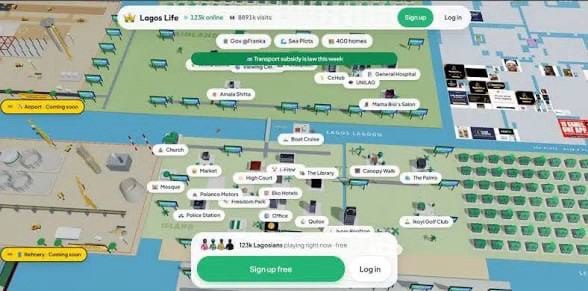
Lagos Life, a browser-based life simulation game set in a virtual version of Lagos, has crossed 1 million players just three days after launch.
The milestone puts the Nigerian-made game in unusual company. ChatGPT took five days to reach 1 million users after launching in November 2022.
But Lagos Life’s rapid growth may point to a bigger story than one viral game. Its success suggests that access, rather than demand, may have been one of the biggest barriers facing Nigerian games.
A link beat the app store
Lagos Life drops players into a Sims-style version of Lagos. Players can meet and chat with others, buy virtual land, run businesses and spend nights in clubs such as Quilox, all from a web browser.
There is no traditional app download or app-store listing. A player can simply click a shared link, create an avatar and enter the virtual city.
Developer Shalom Rayhamen previously acknowledged that the game was inspired by The Sims 3 and Eureka’s Lagos Run, another game built around everyday Lagos experiences.

That low-friction approach may be part of the reason the game spread so quickly.
Instead of asking potential players to find an app in a store, download it and give up storage space before they know whether they will enjoy it, Lagos Life can be accessed directly through a browser.
That also makes it easier for people to share the game on platforms such as X and TikTok.
At 7:15 a.m. on October 5, Lagos Life’s live counter showed 1,173,086 total players, 55,083 people online and 9,122,244 visits in total.
The numbers have continued to move as the game attracts more attention.
Google Trends also showed a sharp increase in Nigerian searches for “Lagos life”, with interest breaking out by more than 5,000% compared with the previous week and peaking at around 10 p.m. on October 4.
Interest was strongest in Ekiti, Ogun, Osun and Lagos, while related searches including “lagos life app” and “lagos life game” also became some of the fastest-rising queries.
Nathan, CEO of Terra Industries, also pointed to the game’s performance on X, describing the moment as evidence that “simulation gaming is entering a new era” of localised experiences.
What earlier Nigerian hits show
The speed of Lagos Life’s growth is unusual, but the idea of turning familiar Nigerian experiences into games is not new.
Africa has a huge and growing gaming audience, but much of the region’s gaming activity has historically centred on global titles such as PUBG Mobile, Call of Duty Mobile, Free Fire and Candy Crush.
Nigerian developers have spent years trying to build local alternatives.
Gamsole, one of Nigeria’s pioneer game studios, passed 10 million global downloads across its catalogue, which included games such as Gidi Run. The studio’s games reached users through traditional platforms including Windows Phone and Android app stores.
Ethiopia’s Qene Games offers another example from the continent. Its games, including Kukulu and Gebeta, have used African settings and culture while reaching audiences beyond the company’s home market.
Lagos Run provides an even closer comparison.
The arcade-style danfo game, created by Nigerian developer Eureka, attracted millions of views across social platforms after its reveal. It was built around the chaotic experience of navigating Lagos in a danfo.

Caption: Lagos Run helped demonstrate the viral potential of games built around recognisable Lagos experiences.
Lagos Life takes that concept much further.
Rather than putting players through a single-session driving experience, it creates a persistent multiplayer world where people can work, socialise, buy property and build virtual lives alongside other players.
That difference could be significant.
A viral game can attract attention once. A multiplayer world has the opportunity to turn that attention into a community.
The harder part for Lagos Life starts now
Crossing 1 million players is a major milestone, but it does not necessarily mean Lagos Life has 1 million regular players.
Someone who opens the game for a few minutes after seeing it on TikTok counts towards the total just as someone who returns every day does.
Retention is therefore the next major test.
Can Lagos Life keep players interested after the initial novelty fades? Can it keep its servers running as usage grows? And can its virtual economy support a sustainable business model?
The game already carries advertisements, which raises questions about how its growing traffic will translate into revenue and whether that revenue can cover its infrastructure costs.
Its in-game economy has also already experienced growing pains.
Hacked accounts reportedly generated trillion-naira balances, forcing the team to reset those balances, restore legitimate money and make changes to the game’s economy. Features such as income tax are also being added.
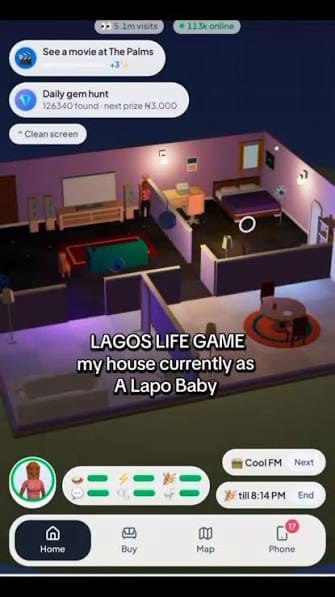
Players have mostly responded to the tax feature with jokes, with some pointing out that they did not expect to escape real-life financial struggles only to encounter them in a virtual Lagos.
A million players could reveal a distribution problem
For years, conversations around African gaming have focused on development: access to funding, better graphics, stronger studios and more opportunities for game developers.
Lagos Life introduces another question: what if distribution is just as important?
The game removes several barriers between discovering a game and actually playing it.
A player does not need to search an app store, download a large file or commit significant storage space before trying it. They can click a link and enter the game.
That does not mean browser games will replace mobile games, and one viral title is not enough to solve the structural challenges facing Nigeria’s gaming industry.
But Lagos Life has demonstrated something worth watching.
A locally relevant game can spread extremely quickly when its setting feels familiar, its entry point is simple and its players can share it instantly.
The million-player milestone therefore matters for more than Lagos Life itself.
If the game can retain a meaningful portion of those players, it could show that Nigerian players were never short of interest in games built around their own experiences.
They may have been short of games that were easy enough to find, cheap enough to access and simple enough to share.