

Nigeria Ranks 6th in Global AI Adoption, Yet Companies Are Slow to Embrace AI
Nigeria’s AI adoption is at a crossroads.
While Nigerian professionals are rapidly embracing artificial intelligence and building globally competitive skills, many businesses are struggling to integrate AI into their operations. This growing disconnect could slow the country’s digital transformation and weaken its position in the global outsourcing market.
According to the 2026 Global Outsourcing AI Readiness Index published by Ataraxis, Nigeria has built one of the world’s most AI-aware workforces, yet its enterprises are failing to fully leverage that advantage.
The report assessed 25 leading outsourcing destinations using four key indicators:
- Workforce AI literacy
- Enterprise AI adoption
- Population AI adoption
- AI education readiness
Nigeria ranked 17th globally with an overall AI readiness score of 49.15 out of 100. However, the data reveals a much bigger story about Nigeria’s digital future.
Nigeria’s AI Adoption Is Being Driven by Workers, Not Businesses
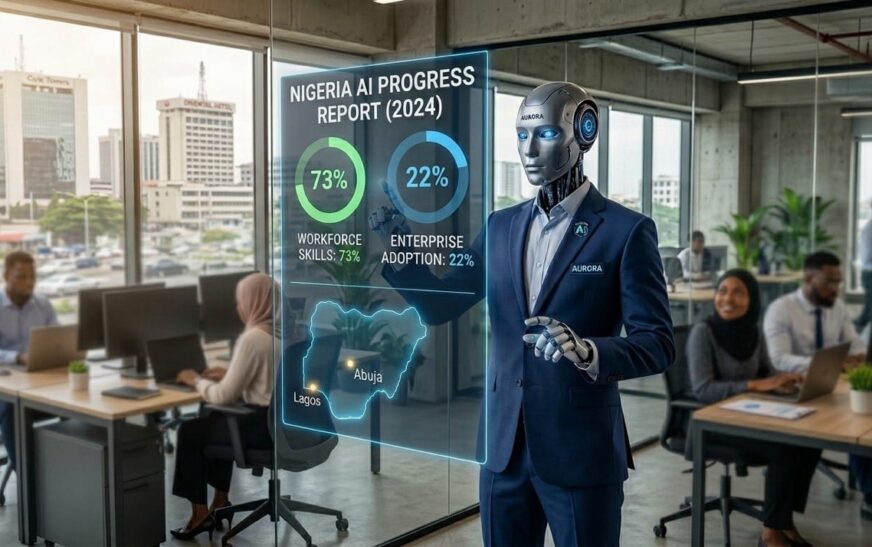
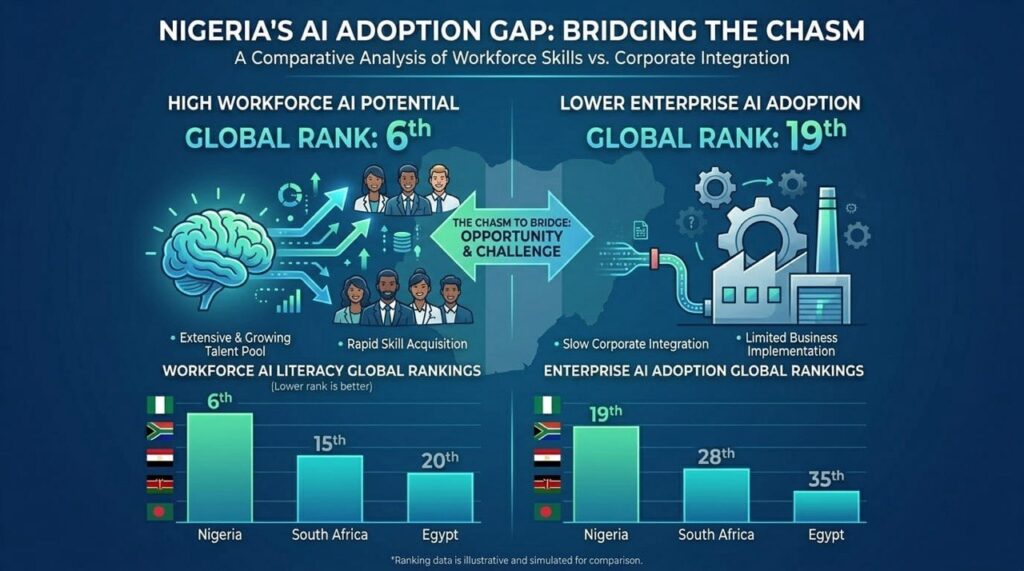
One of the report’s most surprising findings is that Nigeria ranks sixth globally in workforce AI literacy with a score of 66.
Only India, Brazil, the Philippines, Poland, and Malaysia performed better.
This places Nigeria ahead of every other outsourcing destination in Africa and ahead of several countries with more mature digital economies.
The strong ranking shows that Nigerian professionals are proactively learning and applying AI technologies in their everyday work.
Developers, marketers, designers, writers, analysts, and customer support specialists are increasingly using AI tools to improve productivity, acquire new skills, and compete for opportunities in international markets.
However, Nigeria’s AI adoption within businesses tells a very different story.
Nigerian Businesses Are Falling Behind on AI Adoption
Despite the country’s strong workforce performance, Nigeria scored only 34 points in enterprise AI adoption, placing 19th globally.
This creates a 32-point gap between workforce capability and enterprise deployment, the largest disparity recorded among all countries in the index.
The findings suggest that Nigerian workers are embracing AI independently while many organisations remain hesitant to deploy AI across their operations.
This gap is becoming increasingly important because AI readiness is now a major factor in global outsourcing competitiveness.
Companies seeking outsourcing destinations no longer focus solely on labour costs and technical expertise. They are also evaluating how effectively both workers and organisations can utilise AI-powered technologies.
Without faster adoption at the enterprise level, Nigeria risks losing some of its competitive advantage.
Nigeria’s AI Adoption Compared to Other African Countries
Within Africa, Nigeria ranks as the third most AI-ready outsourcing destination.
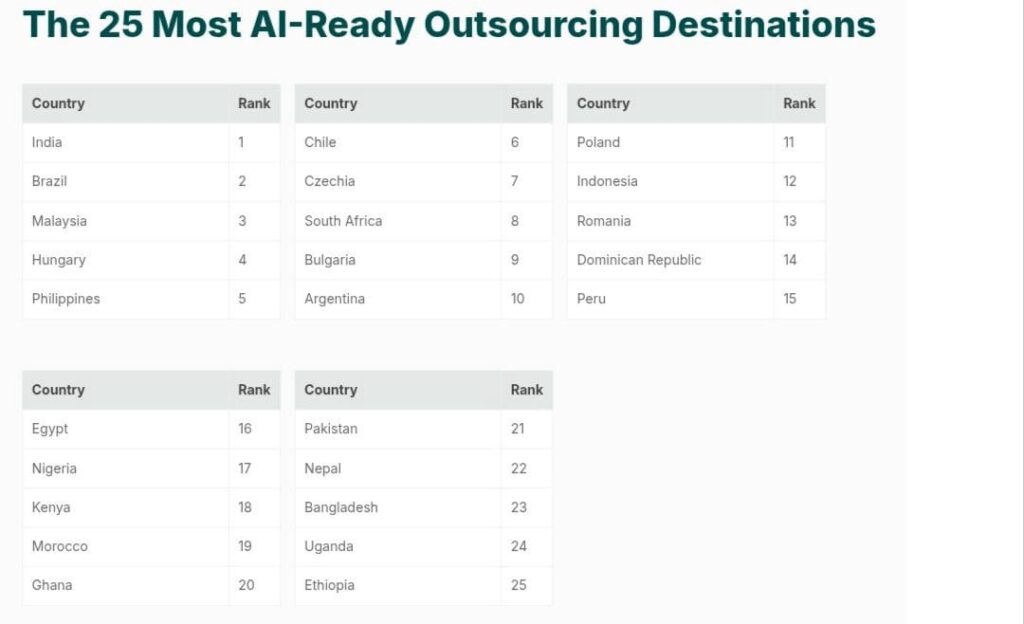
The rankings are:
- South Africa – 66.5
- Egypt – 49.35
- Nigeria – 49.15
The comparison with Egypt is particularly revealing.
Although Nigeria significantly outperforms Egypt in workforce AI literacy, scoring 66 compared to Egypt’s 50, Egypt performs better in three critical areas:
- Population AI adoption
- Enterprise AI adoption
- AI education readiness
This highlights a broader challenge facing Nigeria’s digital economy.
Individuals are adapting quickly to emerging technologies, but institutions are not evolving at the same pace.
Why Nigeria’s AI Adoption Gap Exists
Several factors continue to slow enterprise AI adoption across the country.
These include:
- Inadequate digital infrastructure
- Funding constraints
- Limited AI expertise among business leaders
- Unclear AI implementation strategies
- Cybersecurity concerns
- Weak AI governance frameworks
While employees may already be using AI tools informally, large-scale AI adoption requires strategic investments in technology infrastructure, data security, and workforce transformation.
Without these investments, businesses may fail to maximise the potential of a workforce that is already preparing for an AI-powered future.
Nigeria’s Education System Must Catch Up
The report also ranks Nigeria 19th in AI education pipeline readiness.
This suggests that educational institutions are not producing AI talent at the same speed that professionals are independently acquiring AI skills.
Many Nigerians currently rely on:
- Online courses
- Professional certifications
- Bootcamps
- Self-learning platforms
Although these alternatives have accelerated AI literacy, long-term competitiveness will require stronger institutional support.
Educational institutions, business leaders, and policymakers must work together to modernise curricula, expand AI training programmes, and invest in digital infrastructure.
Nigeria Still Has a Major Competitive Advantage
Despite these challenges, Nigeria remains ahead of several major outsourcing competitors.
The country outperforms Pakistan by 8.55 points and Bangladesh by 16.35 points in overall AI readiness.
Nigeria also maintains a slight advantage over Kenya, another rapidly growing technology hub in Africa.
Perhaps Nigeria’s greatest strength is its human capital.
A sixth-place global ranking in workforce AI literacy demonstrates that Nigerian professionals are already preparing for the future of work.
The next challenge is ensuring that businesses, educational institutions, and government agencies move with the same urgency.

The Bottom Line
Nigeria’s AI adoption is being powered by its people, but businesses are struggling to keep up.
The country does not have an AI talent problem. It has an AI implementation problem.
If enterprises, schools, and policymakers can close this adoption gap, Nigeria could strengthen its digital economy and position itself as one of Africa’s leading AI-powered nations.
Failure to act, however, could prevent the country from fully benefiting from one of its greatest assets: a workforce that is already embracing the future.
Read Also: TikTok’s New AI Tool Could Transform How Nigerian SMEs Advertise