


Imagine being able to check whether a prospective partner has a registered marriage or divorce record before saying “I do” — without having to move between different offices, courts or piles of public records.
That is the idea behind Marrify, a newly launched digital platform in Ghana that brings marriage and divorce records, marriage officers, licensed venues and Islamic marriage authorities into one searchable online system.
The platform was launched in Accra on August 28, 2026, by Marry Right Ghana Limited in partnership with Ghana’s Ministry of Gender, Children and Social Protection. The launch was presented as an effort to improve transparency and help people make more informed decisions before entering marriage.
But Marrify is more than a tool for checking whether someone is married.
It is attempting to digitise and connect records that have historically been spread across government institutions, courts, assemblies, religious bodies and Gazette publications.
What exactly is Marrify?
Marrify describes itself as the Ghana National Marriage & Divorce Registry.
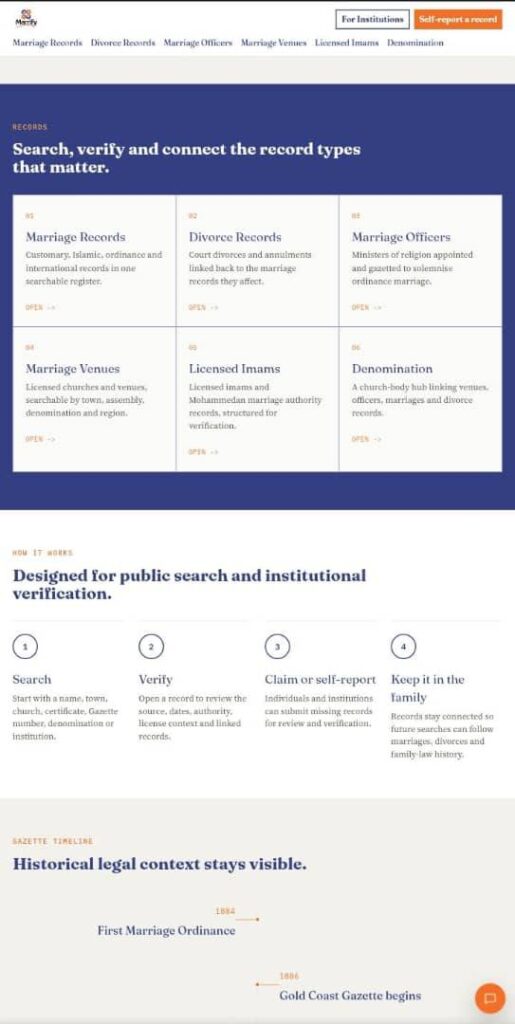
Its website provides separate searchable sections for marriage records, divorce records, marriage officers, marriage venues, licensed Imams and denominations.
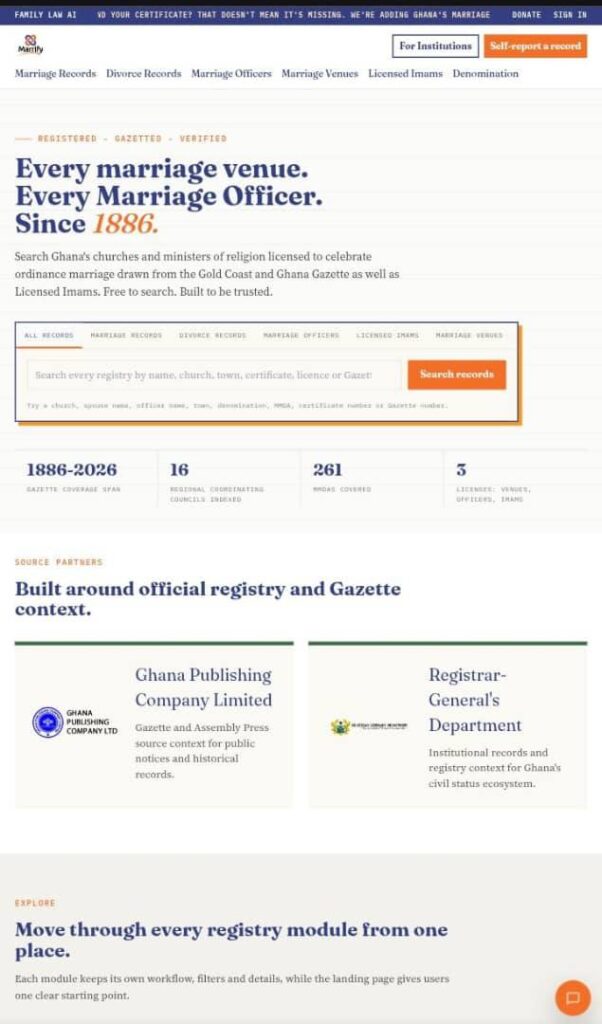
Users can search using information such as a person’s name, spouse’s name, town, church, denomination, certificate number or Ghana Gazette number.
The platform says its database brings together information relating to customary, Islamic and ordinance marriages, while divorce and annulment records can also be connected to the marriages they affect where the relevant records are available.
This essentially turns what could previously require several separate searches into one digital search experience.
So, can you actually check if someone is married?
Yes — but there is an important catch.
Marrify allows users to search its available marriage records by names and other identifying information.
A successful search can reveal details associated with a record, including the parties involved, marriage type, date, venue, certificate information and the authority connected to the record.
The platform also has a dedicated divorce registry where users can search by a party’s name, case number, certificate or court and narrow results by factors such as year, region and divorce type.
However, a “no record found” result should not automatically be interpreted as proof that someone is single.
Marrify itself says records are still being uploaded in stages, meaning some records may not yet be available on the platform.
That distinction is important, particularly if someone is using the platform to make a serious legal or personal decision.
What records does Marrify have?
One of the more ambitious parts of the platform is its historical coverage.
Marrify says its database currently has Gazette coverage spanning 1886 to 2026, alongside records connected to Ghana’s marriage administration.
The platform also says it has indexed all 16 regional coordinating councils and 261 Metropolitan, Municipal and District Assemblies, while tracking three categories of licences covering marriage venues, marriage officers and Imams.
Its founder, Dennis Adjei Dwomoh, said during the launch that the database is being compiled from records dating as far back as 1886, including marriage venues, marriage officers, marriage records and divorce cases.
It is not just about couples
Marrify also allows users to verify the people and places involved in solemnising marriages.
The platform has searchable information on:
- Marriage officers authorised to solemnise ordinance marriages
- Licensed marriage venues
- Licensed Imams
- Churches and denominations
- Marriage records
- Divorce and annulment records
This could be particularly useful for people who want to confirm whether a church, venue or individual is authorised to conduct a particular type of marriage.
Where does the information come from?
Marrify says its records are built around official and institutional sources, including Ghana Gazette records and information connected to the Registrar-General’s Department.
The platform also provides portals for institutions such as MMDAs, churches, courts and the Registrar-General’s Department to submit or manage records.
That institutional component is important because the usefulness of a searchable registry depends heavily on whether the underlying information is accurate and regularly updated.
At the launch, Ghana’s Gender Minister, Dr Agnes Naa Momo Lartey, specifically urged Marry Right Ghana to work with government institutions, religious bodies, traditional authorities and other stakeholders to ensure the platform’s information remains accurate, reliable and regularly updated.
What happens if your record is missing?
Marrify also has a claim and self-reporting system.
Individuals and institutions can submit information about missing records, after which the information can go through the platform’s verification process.
That means Marrify isn’t simply a static database of old documents. It is designed to become a continually updated registry as more records are added and verified.
Also Read: Reasons African Fintech Startups Are Raising Again
Still, the platform’s current warning that records are being uploaded in stages means users should treat the database as a growing registry rather than assume that every marriage or divorce in Ghana is already searchable.
Marrify also has an AI assistant for family law
There is another interesting part of the platform that goes beyond record searching.
Marrify includes a Family Law AI designed to help users with questions around Ghanaian family law, research, drafting and document review.
Its associated app says the AI can answer questions about Ghanaian marriage law and provide the statutes and cases it relied on, allowing users to check the sources behind its answers.
However, the service makes clear that its AI provides general information and is not a substitute for advice from a qualified lawyer.
Why this could matter for Ghanaians
Marriage records are not just useful on the day two people decide to get married.
They can become important years later in matters involving inheritance, property, divorce, widowhood rights and family disputes.
That is one reason Marrify’s creators are positioning the platform as more than a matchmaking or background-checking tool.
For Ghanaians living abroad, the platform also says its records can support verification involving personal documentation, courts and embassies.
The bigger idea is simple: make marriage-related records easier to find, connect and verify.
But Marrify’s biggest challenge may be trust
Putting records online is only half the job.

For Marrify to become genuinely useful as a national verification tool, people and institutions need to trust that the records are accurate, complete and regularly updated.
A missing record cannot necessarily mean that a person has never been married. Likewise, information submitted to the platform needs to be properly verified before it is treated as authoritative.
That makes the platform’s partnerships with government institutions, courts, assemblies and religious bodies particularly important.
If Marrify can continue expanding its database while maintaining reliable verification, it could significantly change how people in Ghana check marriage-related information.
For now, though, it is best viewed as a new and growing digital registry, not an infallible database of every marriage in Ghana.
And perhaps that is the most interesting part of the launch: Ghana is moving another traditionally paper-heavy part of everyday life onto the internet, one searchable record at a time.