

Foldable phones are not new.
Samsung has been making them for years. Huawei, Motorola and other manufacturers have also spent years trying to convince smartphone buyers that a phone that folds is worth paying more for.
Yet, something feels different now.
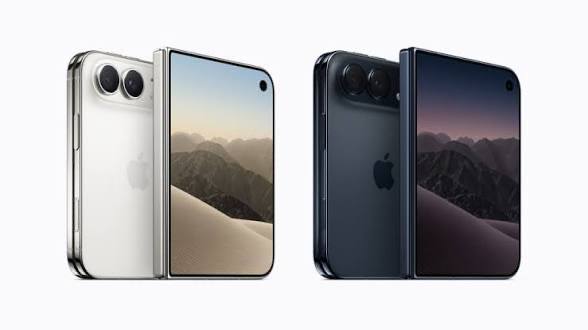
Apple has finally entered the foldable market with the iPhone Duo, and suddenly the category is attracting attention from people who may never have seriously considered buying a foldable phone before.
That is the interesting part of Apple’s first foldable.
It is not that Apple invented the technology. It did not.
It is that Apple has taken a product category that has largely remained a premium niche and put the iPhone name behind it.
The result is a $1,999 smartphone that opens into a 7.6-inch display, runs Apple’s latest A20 Pro chip and is designed to work more like a phone and small tablet in one device.
So why is the iPhone Duo getting so much attention?
Foldable phones have been around for years
Before Apple arrived, Samsung had already spent years developing its foldable lineup.
Samsung introduced its first Galaxy Fold in 2019 and has since released multiple generations of foldable phones. Other manufacturers, particularly in China, have also pushed the technology forward.
That means Apple is not entering an empty market.
It is entering a market where competitors have already worked through many of the early problems surrounding folding displays, hinges, thickness and durability.
Reuters reports that Samsung has responded to Apple’s entry by highlighting its experience in foldables and promoting its latest devices. The company has also used the moment to remind consumers that it has been in the category since 2019.
But Apple’s late arrival may actually be part of the reason the Duo is attracting so much attention.
Must Read: Everything You Need to Know About the iPhone 18 Series
Apple has a massive existing iPhone customer base, and it can introduce a new form factor to people who have never considered leaving the conventional iPhone design.
Apple finally made a foldable iPhone
For years, one of the biggest questions in the smartphone industry was not whether Apple could make a foldable phone.
It was when Apple would make one.
Now we have the answer.
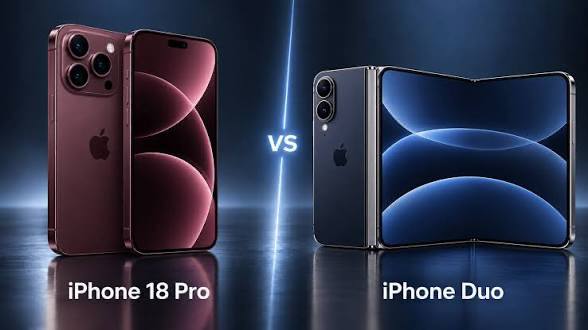
The iPhone Duo is Apple’s first foldable iPhone, and its design is deliberately different from the company’s conventional models.
When closed, it has a 5.4-inch outer display that can be used like a normal iPhone.
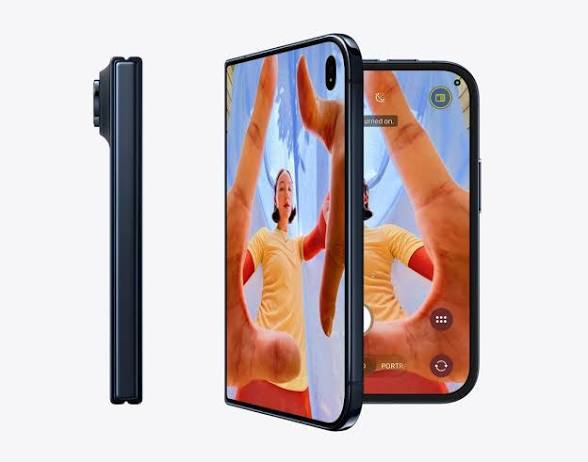
Open it up and that becomes a 7.6-inch Super Retina XDR OLED display.
Apple says the inner screen is 50 percent larger than the iPhone 18 Pro Max’s display, while the outer screen provides 90 percent of the screen area of the iPhone 18 Pro.
That is the basic idea behind the Duo:
Carry a phone. Open it when you need a bigger screen.
It is not just a bigger screen
The appeal of the Duo goes beyond having more display space.
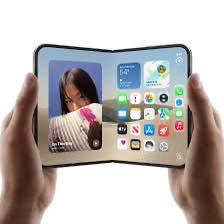
Apple has redesigned iOS 27 specifically for the foldable.
When the phone is opened, the interface can adapt to the larger display, with Apple moving certain controls and navigation elements to make better use of the available space.
Apps can also take advantage of the larger screen.
Apple says apps including Netflix, Zoom and Slack are already being adapted for the Duo, allowing users to see more content or work with multiple elements on screen at once.
That matters because a foldable phone is only useful if the software knows what to do with all that extra screen.
Apple is essentially trying to make the transition between a normal iPhone and a larger-screen device feel automatic.
The Duo is surprisingly thin
One of the things that makes the iPhone Duo particularly interesting is its size.
When opened, the phone is just 5.2mm thick.
It weighs 254 grams and uses a titanium foldable design.
Apple has also equipped it with Ceramic Shield 2 on the front and Ceramic Shield on the back, while the device carries an IP68 rating for water and dust resistance.
For a device containing two displays, a hinge and two batteries, keeping the body this thin is a significant part of Apple’s pitch.
It also helps the Duo feel less like a bulky tablet that happens to fold and more like an iPhone that happens to become much larger.
Then there is the 7.6-inch display
This is probably the biggest reason someone might actually buy the Duo.
The inner display measures 7.6 inches and uses OLED technology with ProMotion up to 120Hz.
It also has a nano-texture finish designed to reduce glare and reflections.
Apple says the design helps minimise the visibility of the crease in the folding display.
That is important because the crease has been one of the most noticeable compromises of foldable phones.
Apple is clearly trying to make the Duo feel less like a first-generation experiment and more like a finished premium product.
Apple gave the Duo some unusual camera tricks
The iPhone Duo also does things that would be difficult to replicate on a conventional iPhone.
It has a 48MP Dual Fusion camera system, consisting of a 48MP Fusion Main camera and a 48MP Fusion Ultra Wide camera.
The main camera also provides a 2x optical-quality telephoto option.
But the more interesting part is what Apple does with the two displays.

Duo Preview
With Duo Preview, people being photographed can see a live preview on the outer display.
That means someone taking your picture can show you exactly how you are positioned in the frame before the photo is taken.
It is a small feature, but it demonstrates why a foldable can offer experiences that a conventional phone cannot.
Duo FaceTime
The two displays can also be used during FaceTime.
Apple says Duo FaceTime allows someone on the other side of the phone to join a video call using the outer display and camera.
The company has also added Dual Capture, allowing the phone to record from front and rear cameras simultaneously.
These features make the folding design more than a visual gimmick.
Apple Pencil support makes the big screen more useful
Another reason the Duo is attracting attention is Apple Pencil support.
Apple says the phone will support the USB-C Apple Pencil on both displays later this year.
That gives the 7.6-inch screen another purpose beyond watching videos and browsing websites.
Users can take notes, sketch and mark up documents directly on the larger display.
It also strengthens Apple’s argument that the Duo can replace some of the situations where people would normally reach for a tablet.
Apple did something unexpected with Face ID
There is another major difference between the Duo and recent flagship iPhones.
The iPhone Duo uses Touch ID built into the side button.
The inner display instead has an under-display FaceTime camera, keeping the large folding screen free from a traditional camera cutout.
This is a notable change for Apple.
Rather than trying to squeeze its traditional Face ID system into the foldable design, the company has chosen a fingerprint sensor for authentication.
Whether users will prefer this approach remains to be seen.
It has the same A20 Pro chip as Apple’s new Pro iPhones
The Duo is not a lower-powered foldable.
Apple equipped it with the A20 Pro chip, the same processor used in the iPhone 18 Pro models.
Apple says the chip has a six-core CPU, seven-core GPU and dual 16-core Neural Engine.
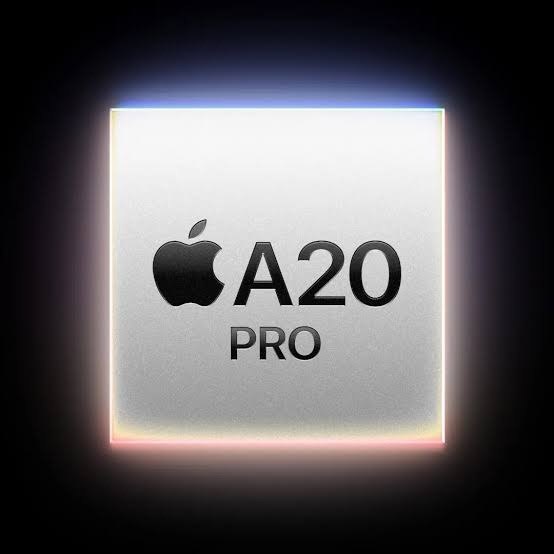
The company also says the A20 Pro provides up to 35 percent better sustained performance than the iPhone 17 Pro, with the new thermal system helping the phone maintain performance during gaming, multitasking and demanding AI workloads.
So the Duo is not simply Apple’s experimental foldable.
It is a flagship iPhone with a completely different body.
The battery is built around the folding design
Apple has placed a battery on each side of the phone.
Together, the batteries provide up to 24 hours of use when both displays are used equally.
Video playback is rated at up to 44 hours using the outer display or up to 31 hours using the inner display.
The phone can also reach up to 50 percent charge in around 20 minutes using a 60W-capable adapter or higher.
The dual-battery arrangement allows Apple to make better use of the space inside the two halves of the phone.
And then there is the price
This is where the excitement gets complicated.
The iPhone Duo starts at $1,999 in the US for 256GB.
It is available with 256GB, 512GB, 1TB and 2TB of storage.
That makes it considerably more expensive than the iPhone 18 Pro, which starts at $1,199, and the iPhone 18 Pro Max, which starts at $1,299.
So Apple is not pretending the Duo is an affordable iPhone.
It is positioning it as a premium device for people who specifically want the foldable experience.
And that raises an interesting question.
Are people interested in the Duo because they actually need a foldable phone, or because Apple has finally made one?
Apple’s biggest advantage may not be the hardware
This could ultimately be the most important part of the entire story.
Samsung has more experience with foldable phones.
Chinese manufacturers have also pushed foldable hardware aggressively.
Apple’s advantage is something different: its ecosystem.
Millions of people already use iPhones, Macs, iPads, Apple Watches and AirPods.
For an existing iPhone user who has been curious about foldables but did not want to leave Apple’s ecosystem, the Duo removes one of the biggest barriers.
You do not have to switch to Android to try a foldable anymore.
You can stay inside Apple’s ecosystem and get the new form factor.
That could be far more important to the foldable market than another incremental hardware improvement.
Apple could make foldables mainstream
This is where the iPhone Duo becomes bigger than one phone.
Foldables have existed for years, but they remain a relatively small part of the overall smartphone market.
Apple’s entry could change that.
The company has repeatedly demonstrated that it does not necessarily need to invent a product category to make it mainstream.
The Apple Watch did not invent smartwatches.
The iPhone did not invent smartphones.
The iPad did not invent tablets.
Apple’s strength has often been taking an existing category, combining hardware and software tightly, and putting its own ecosystem around it.
The Duo is now attempting to do something similar with foldables.
But Samsung has a head start
Apple’s arrival does not erase the competition.
Samsung has been refining foldables since 2019 and has already released multiple generations of Galaxy Z Fold and Z Flip devices.
Also Read: Samsung’s Next Big Thing? 9 Futuristic Gadgets That Could Arrive Sooner Than You Think
The company is now directly responding to Apple’s arrival, emphasizing its experience and the progress it has made with thinner and lighter foldables.
That makes the competition particularly interesting.
Samsung spent years convincing consumers that foldables were worth considering.
Apple has now entered the same market with a completely different advantage: a huge existing customer base and a deeply integrated ecosystem.
The question is no longer whether foldables can become mainstream.
It is whether Apple can make them mainstream enough to justify the price.
So, why is everyone suddenly interested?
The iPhone Duo is not the first foldable.
It is not even necessarily the most technologically adventurous foldable on the market.
What makes it different is the combination of factors.
It is an iPhone.
It opens into a 7.6-inch display.
It is only 5.2mm thick when unfolded.
It runs Apple’s latest A20 Pro chip.
It supports Apple Pencil.
It has cameras designed around the folding form factor.
And, perhaps most importantly, it gives millions of existing iPhone users a way to try a foldable without leaving Apple’s ecosystem.
That is why the Duo has the potential to make foldable phones impossible to ignore.
The bottom line
Apple did not invent the foldable phone.
Samsung and other manufacturers were already selling them long before the iPhone Duo arrived.
But Apple may have done something just as important: it has turned the foldable iPhone into a product that millions of people are suddenly curious about.
At $1,999, the Duo is far from an impulse purchase.
Whether consumers are willing to pay that much for a phone that transforms into a larger screen will determine whether Apple’s first foldable becomes a new mainstream category or remains a premium niche.
For now, one thing is clear.